










November 2025
Want a quick summary?

Read the executive summary of the November 2025 Economic and fiscal outlook.
"It is the duty of the Office to examine and report on the sustainability of the public finances"
|
We expect average GDP growth of 1½ per cent over the next five years, 0.3 percentage points slower than in March. Lower GDP growth coupled with higher forecast inflation, wages, receipts, and spending results in a modest deterioration in the pre-measures fiscal position, with borrowing £6 billion higher and the current surplus reduced to £4 billion in 2029-30. Against this backdrop, the Budget delivers a frontloaded increase in spending of £9 billion and backloaded increase in taxes of £26 billion. This doubles the current surplus to £22 billion in 2029-30 but also leaves debt 2 per cent of GDP higher than in March.
November 2025
Read the executive summary of the November 2025 Economic and fiscal outlook.
An explainer exploring how the fiscal costs of climate-related damage and the transition to net zero could affect the UK’s economy and public finances.
An explainer covering the risks relating to the UK’s public balance sheet.
Asha Turner and Bronwyn Garrett | 2 October 2025
This article sets out how the OBR is developing its approach to scrutinising and assessing compliance measures, and further work we plan to do in this area.
Joshua Rawlings | 11 September 2025
In this article we provide an explanation of our forecasting process for the trend participation rate. We discuss how we use a cohort model, which combines Labour Force Survey data and ONS population projections, to inform this forecast. We also explain how we make adjustments for future changes in the state pension age and incorporate other judgements.
Lawrence Lam | 14 August 2025
In this article, we provide more detail underpinning our judgement on the reforms’ supply-side impact, specifically on the higher construction sector productivity we judged the reforms would enable, alongside supporting evidence and the resulting implications for our economy forecast.
Chloe Baker and Laura Gardiner | 12 December 2024
In this article, we explore the impact of population health on the medium-term economic and fiscal outlook, highlighting the risks poor health poses to the long-term sustainability of public finances.
Amy Nash | 11 July 2024
In this article, we set out how we put the PAYE income tax forecast together in our biannual Economic and fiscal outlooks; how new distributional analysis of earnings informs and improves our forecast; and what our latest forecast assumes about earnings growth across the distribution.
Katya Ring, Holly McCurry, Rosanna Colthorpe and Joshua Rawlings | 11 January 2024
In this article, we examine the reasons for the consistent downwards trend in inactivity for caring purposes coming to an end and what it might imply for our forecast for overall labour force participation.
Staff of the OBR | 9 November 2023
In this article, we set out how the OBR’s economic and fiscal forecasts capture the dynamic effects of policies on the economic behaviour of people and businesses.
Balint Benke and João Sousa | 12 October 2023
Our new ready reckoner allows users to obtain quick, indicative estimates of how changes in the economy affect public finances.
Luke Lanskey and Conor O’Loughnan | 20 July 2023
Our new historical public finances database contains 300 years of tax, spending, borrowing and debt data. This article tells the story of government borrowing and debt since 1700 and how the level and composition of tax and spending have evolved over this period.
Five year forecasts for the UK economy and public finances and an assessment of whether the Government is likely to achieve its fiscal targets.
Report into the main fiscal risks facing the UK and sustainability of the public finances.
Assessment of how our forecasts compare to outturn data and identifying lessons for future forecasts.
An in-depth look at the drivers of welfare spending both inside and outside the Government’s welfare cap.
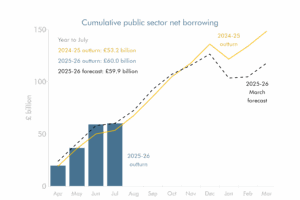
Our monthly commentary on the latest public finances data and how it compares to our most recent forecast.
We are commissioned by the Welsh Government to produce independent forecasts for devolved Welsh taxes.
Briefing papers describe our work and explain the material we present.
As part of the OBR work programme we will produce working papers on topics which will inform discussion on our forecasts.
The OBR publishes discussion papers to generate debate around key aspects of its work. Our occasional papers are publications that are not part of a wider set of releases.